
ImpossibleHunt
28 𝐘𝐞𝐚𝐫 𝐎𝐥𝐝 𝐔𝐧𝐢𝐯𝐞𝐫𝐬𝐢𝐭𝐲 𝐆𝐫𝐚𝐝𝐮𝐚𝐭𝐞/ Future Aerospace Control Officer (AEC)/ - 𝑪𝒂𝒏𝒂𝒅𝒊𝒂𝒏 𝑨𝒓𝒎𝒆𝒅 𝑭𝒐𝒓𝒄𝒆𝒔 2026 - Officially Accredited Socionist/ World Socionics Society (2026)
Analyses by ImpossibleHunt

𝐍𝐚𝐩𝐨𝐥𝐞𝐨𝐧 𝐁𝐨𝐧𝐚𝐩𝐚𝐫𝐭𝐞 𝐢𝐬 𝐚𝐧 𝐒𝐋𝐄 (𝐄𝐒𝐓𝐩)
"𝘛𝘩𝘦 𝘣𝘢𝘵𝘵𝘭𝘦𝘧𝘪𝘦𝘭𝘥 𝘪𝘴 𝘢 𝘴𝘤𝘦𝘯𝘦 𝘰𝘧 𝘦𝘲𝘶𝘢𝘭 𝘤𝘩𝘢𝘰𝘴. 𝘛𝘩𝘦 𝘸𝘪𝘯𝘯𝘦𝘳 𝘸𝘪𝘭𝘭 𝘣𝘦 𝘵𝘩𝘦 𝘰𝘯𝘦 𝘸𝘩𝘰 𝘤𝘰𝘯𝘵𝘳𝘰𝘭𝘴 𝘵𝘩𝘢𝘵 𝘤𝘩𝘢𝘰𝘴, 𝘣𝘰𝘵𝘩 𝘩𝘪𝘴 𝘰𝘸𝘯, 𝘢𝘯𝘥 𝘵𝘩𝘦 𝘦𝘯𝘦𝘮𝘪𝘦𝘴."
Napoleon is a person who is known to have an exceptional proclivity towards ambition and would do anything to secure his own power and influence (F1). To support this endeavor, Napoleon was an avid scholar of mathematics, artillery (which was a new field at the time and required extensive precision, physics, and environmental science), past military conquests, law, and military strategy.
Not only this, but Napoleon created structures that fundamentally revolutionized how wars were fought and how nations were governed. The Napoleonic Code that applied to all nations in his control (that served to distance itself from the feudal nations surrounding France), the Lycee system (which centralized and secularized French education), etc. This demonstrates a fluid, flexible, comfortable, and consistent use of Laws (L) to support his ambitions—L2.
Napoleon was notably charismatic and was very successful in gaining the allegiance/loyalty of his troops, and his speeches were always noted to rouse the crowd. He knew how to craft an image of himself, etc. This is a skill he very much "grew into," as he spent the majority of his childhood and upbringing socially awkward and heavily introverted, even describing his younger self as being as "dry as parchment." Internally, he deeply craved status and respect, and was very susceptible to damage and criticism in this area, being known for his explosive temper and volatile temperament when exposed to frustration. This inconsistent/often volatile but valued use of emotion points to E6.
This focus on external expression and charisma (E) compensates for his lack of focus on relations (R). He simply prioritized using his raw military might and political power to suppress his competition. He also had a habit of misreading people often, assuming that structural loyalties and positive results alone were more important to consider. For example, he would often place his family into positions of power, believing that "blood ties" would automatically keep people forever loyal (Ti > Fi), just to have them mismanage their respective kingdoms and even work against him.
He would also keep people he did not trust in his inner circle, such as Charles-Maurice de Talleyrand. He disliked his character but kept him around because of Talleyrand's immense skill as a diplomat. Unsurprisingly, he would betray Napoleon numerous times, scheming with Austria and Russia. This would happen again with figures such as Joseph Fouché, a famed and skilled spymaster, whom Napoleon reappointed after he secretly negotiated with Britain behind his back (who would, unsurprisingly, betray him again). Again, his focus on pragmatism and a need to preserve his empire were more important than judgements.
But more importantly, his first marriage to Josephine is important to highlight.
Josephine's biographer, Carolly Erikson, noted that she "followed her head, then her heart." She was someone who, as the mistress to many influential officers, cultivated relationships with men who could suite her financial and material needs and saw Napoleon as another man with that potential to support her renowned reputation as a spendthrift. She clearly did not like Napoleon at first, and Napoleon would spend much time questioning her true feelings towards him.
Despite these political betrayals (and Napoleon's own affairs), he is very poor at establishing the appropriate boundaries to protect himself from relational harm, and he does not place a lot of energy into this area, often prioritizing immediate pragmatism or highlighting structural loyalty in higher esteem, which indicates R4.

Winston Churchill is an SLE (ESTp)
"You have enemies? Good. It means you've stood up for something."
(Se-Ti)
Ever since he was a young boy, Winston dreamed of securing fame and glory through military participation. He did not fear conflict; he actively sought it out and embraced it wholeheartedly. Viewing it as a game that was honourable, and a worthwhile endeavor to pursue. This is a consistent behavior seen throughout his life, and later an exceptionally varied political career. Much of what distinguished him as a politician was an ability to capitalize on in-the-moment opportunities and his boldness to assert himself.
"War, which used to be cruel and magnificent, has now become cruel and squalid. In fact, it has been completely spoilt."
The Happy Warrior: Winston Churchill and the Representation of War, 1895–1901
Additionally, Churchill spent much of his time examining the role of structures, and how they contributed to his pursuit of glory (and the glory of Britain). During his military travels, he voraciously absorbed various systems and structures in literature, such as Plato, historical writings by Edward Gibbon, science, and economics. This loyalty to structures (instead of individual relationships) contributed to his outdated view of the British Empire, which led to him being... rather difficult to deal with as a politician during peacetime. He would impose structures such as "Gold Standard" (which would end up overvaluing the British pound), and would vehemently oppose India's self-governance, deeming it a threat to the Empire (to the point of ostracizing him from his allies). That ideological rigidity (when he allies himself with a specific system) would later serve him well during wartime, refusing to compromise with Nazi Germany even if the world did not stand with him.
(Fi Vulnerable -> Fe Mobilizing)
Churchill also cared deeply about emotions (E), but only a specific manifestation of emotions. He had a reputation as a politician and in his personal life as being charismatic and possessing a certain wit but would often come across as excessively harsh, and had a difficult time masking his volatile temper. He prided himself on being jovial and maintaining an upbeat attitude and found that his sudden temper was often a hinderance, something that dehabilitated him for what he sought to do and achieve.
"Anger is a waste of energy. Steam, which is used to blow off a safety valve, is better used to drive the engine."
Additionally, he had a struggle with assessing motivations that were not clearly emotive or demonstrated. If someone said it to be true, he believed them. As a result, he was highly susceptible to flattery. Canadian prime minister Mackenzie King noted that Churchill frequently told King of the effectiveness of flattery and was not "sparring of his use of it." His own wife, Clementine, was keenly aware of his weakness and worked keenly to protect Churchill from being too trusting of people who feigned loyalty or were just entertaining. She would also gently (but firmly) criticize her husband if his temper, and his inability to regulate his own emotions would jeapordize his long-term goals; famously writing a letter to Churchill (when his own staff went to her for support against Churchill's volatile temperament) stating...
"There is a danger of you being generally disliked by your colleagues... You are not as kind as you used to be."
Churchill, after receiving this letter, immediately sought to correct his behavior and to quell his temper, proving he is susceptible to advice in this area and again seeking to make himself more well-liked by his peers. He shows a clear preference and focus on creating a jovial atmosphere, struggles with maintaining this consistently, and suffers from poor emotional regulation/"blowouts" when confronted with negative external reactions. This is typical of Fe mobilizing.

𝐀𝐝𝐨𝐥𝐟 𝐇𝐢𝐭𝐥𝐞𝐫 𝐰𝐚𝐬 𝐚𝐧 𝐄𝐈𝐄 (𝐄𝐍𝐅𝐣)
"𝘐 𝘶𝘴𝘦 𝘦𝘮𝘰𝘵𝘪𝘰𝘯 𝘧𝘰𝘳 𝘵𝘩𝘦 𝘮𝘢𝘯𝘺 𝘢𝘯𝘥 𝘳𝘦𝘴𝘦𝘳𝘷𝘦 𝘳𝘦𝘢𝘴𝘰𝘯 𝘧𝘰𝘳 𝘵𝘩𝘦 𝘧𝘦𝘸.”
Obvious Extroverted Feeling (Fe) leading with Ni Creative, as his greatest ability was to imbue his followers with passion, emotion, and the emotional will to commit reprehensible atrocities. His speeches contained very little empirical fact or logical consistency, but rather, played on crowd psychology, and he specifically trained and fine-tuned his orating skills over time to leave a maximum impact on his audiences. According to Daniel Binchy, who as a student attended Hitler's speeches (and would later become the Irish ambassador to Berlin), he noted that Hitler was very gifted in his oration.
He would first stumble over his opening statements, but then once he got settled, he would "all at once he seemed to take fire. His voice rose victorious over falterings, his eyes blazed with conviction, and his whole body became an instrument of rude eloquence." Even if his statements were sometimes contested by some heckles, the vast majority of his orations resulted in thunderous applause.
"As we left the meeting my friend asked me what I thought of this new party leader. With all the arrogance of 21 I replied: ‘A harmless lunatic with the gift of oratory.’ I can still hear his retort: ‘No lunatic with the gift of oratory is harmless.’”
What Hitler struggled with immensely was creating a nuanced logical framework to base his ideology off of. His "work" (and I use this term loosely), Mein Kampf, is largely regarded by contemporary scholars, historians, linguists, and literary critics to be lacking in internal consistency, tedious, and overall poorly written. His speeches also lack specifics but rather play on social fears, anger, and economic despair. This is despite Hitler actively seeking a replacement of post-WW1 Germany with his Reich, but lacked the means to explain the subtle changes himself. He left the actual logistics of the plan to his subordinates.
Hitler was just quite simply not an Fe Ignoring type (such as the ESI). Those types, while they can be emotive at times, do not typically use external emotionality to influence people to "feel" a certain way (as Hitler quite clearly did by historical accounts). ESIs are individuals who use "relations"(Fi) to deepen specific interpersonal relationships, or quickly enforce those boundaries through Extroverted Sensing (Se).

Silco is an LIE (ENTj)
"Is there anything as undoing as a daughter?"
(Te-Ni Ego)
First and foremost, Silco is a pragmatist that seeks to free Zaun from its oppression under Piltover. He is not someone who values ideological consistency but rather results. "How do my plans fit into my long-term goals?" As a result, simply because of that aforementioned pragmatism, he allowed the flow of Shimmer (a highly potent and addictive drug) into his streets, simply to build the capital and military force capable of standing up to the capital. He is also very adaptable to planning within chaos, which is an important distinguishing element from LSI.
He can accelerate timelines rapidly with changing information, adapting his strategy significantly to a catastrophic loss in Act 1 (where he loses his entire refinery because of Powder's monkey bomb). Recognizing the Hextech crystal brought by Jinx for the significance it is, he largely switched his goals entirely from shimmer, to developing a weapon (using tech he was previously completely unaware of) to level the playing field. Most significantly, the fact he was willing to consider establishing a peace deal with Piltover, when Jayce unexpectedly brought everything he ever wanted on a silver platter, indicates a lack of ideological rigidity or attachment to a worldview predicated on conflict.
His adaptability in chaos and allowing potential outcomes and possibilities to change his strategies consistently, indicates higher iNtuition than sensing.
In return, this makes Silco both devalue the "day-to-day trivialities" in his pursuit of his future goals (Si Vulnerable). He does not hyperfixate on details but rather the long-term vision of what he seeks to achieve. He prioritizes movement, and does not let himself rest, as he feels his future goals are too important to let "just sit." As a result, you'll find that Silco has his hands involved in many different plans and ventures, never sitting still and "smelling the roses."
(Fi Suggestive)
Silco's greatest weakness (and source of change) is regarding his relationships, which is the realm of relations. He deeply values concrete displays of loyalty, and takes great care to secure it from the people who follow him (Fi-Se). Vander's betrayal follows Silco for decades and fuels his rebellion against Piltover, but simultaneously, his relationship with Jinx, while at times exceptionally toxic, enables him to grow as a person (being moved from originally intending to murder her, sparing her life with a gesture as simple as a desperate hug). His deepest relationships lead to outright preferential treatment, and even Silco becomes far "warmer" than the cold, calculating persona he might typically give off to others.
This valuing of relationships comes to even greater importance than his long-term goals, in which Silco would jeopardize the well-being of Zaun and everything he strived for decades to achieve, just to save his daughter. This conflict stirs within him, causing him a great amount of emotional turmoil.
His receptiveness to relations alone greatly distinguishes him from LSI, who adopt relational roles to largely fill societal expectations (Fi Role), but favour consistency in regard to people (Ti-Fe). He even admits in his dying words that he resounds in the fact that he would have never given up Jinx for any deal in the world. Assuring her before be passed away that he loves her for who she is, even in death.

Levi Ackerman is a Self-Preservation E4
~ Revamped ~
"𝘈𝘴 𝘢 𝘬𝘪𝘥, 𝘓𝘦𝘷𝘪 𝘶𝘴𝘦𝘥 𝘵𝘰 𝘮𝘢𝘬𝘦 𝘩𝘪𝘮𝘴𝘦𝘭𝘧 𝘴𝘵𝘳𝘰𝘯𝘨𝘦𝘳 𝘪𝘯 𝘰𝘳𝘥𝘦𝘳 𝘵𝘰 𝘳𝘦𝘤𝘦𝘪𝘷𝘦 𝘱𝘳𝘢𝘪𝘴𝘦 𝘧𝘳𝘰𝘮 𝘒𝘦𝘯𝘯𝘺. 𝘉𝘶𝘵 𝘰𝘯𝘦 𝘥𝘢𝘺, 𝘢𝘭𝘭 𝘰𝘧 𝘢 𝘴𝘶𝘥𝘥𝘦𝘯, 𝘒𝘦𝘯𝘯𝘺 𝘸𝘢𝘴 𝘯𝘰 𝘭𝘰𝘯𝘨𝘦𝘳 𝘣𝘺 𝘩𝘪𝘴 𝘴𝘪𝘥𝘦 𝘢𝘯𝘥 𝘭𝘦𝘧𝘵 𝘩𝘪𝘮 𝘸𝘪𝘵𝘩 𝘢 𝘲𝘶𝘦𝘴𝘵𝘪𝘰𝘯: “𝘛𝘩𝘦𝘯 𝘸𝘩𝘢𝘵 𝘪𝘴 𝘮𝘺 𝘴𝘵𝘳𝘦𝘯𝘨𝘵𝘩 𝘧𝘰𝘳?
𝘞𝘩𝘦𝘯 𝘒𝘦𝘯𝘯𝘺 𝘴𝘢𝘪𝘥, “𝘌𝘷𝘦𝘳𝘺𝘰𝘯𝘦 𝘪𝘴 𝘦𝘯𝘴𝘭𝘢𝘷𝘦𝘥 𝘣𝘺 𝘴𝘰𝘮𝘦𝘵𝘩𝘪𝘯𝘨,” 𝘢𝘯𝘥 𝘲𝘶𝘦𝘴𝘵𝘪𝘰𝘯𝘦𝘥 𝘓𝘦𝘷𝘪 “𝘞𝘩𝘰𝘴𝘦 𝘴𝘭𝘢𝘷𝘦 𝘢𝘳𝘦 𝘺𝘰𝘶?” 𝘓𝘦𝘷𝘪 𝘢𝘭𝘴𝘰 𝘳𝘦𝘤𝘰𝘨𝘯𝘪𝘻𝘦𝘥 𝘵𝘩𝘢𝘵 𝘩𝘦 𝘪𝘴 𝘵𝘦𝘵𝘩𝘦𝘳𝘦𝘥 𝘵𝘰 𝘩𝘪𝘴 𝘰𝘸𝘯 𝘴𝘵𝘳𝘦𝘯𝘨𝘵𝘩, 𝘢𝘴 𝘸𝘦𝘭𝘭 𝘢𝘴 𝘵𝘩𝘦 𝘥𝘶𝘵𝘺 𝘰𝘧 “𝘐 𝘮𝘶𝘴𝘵 𝘣𝘦𝘤𝘰𝘮𝘦 𝘢 𝘩𝘦𝘳𝘰.”
- Hajime Isayama
Levi's relationship with Kenny is often a subject that is completely ignored when talking out the former's character, his motivations, and why Levi feels an unwavering commitment to the cause. Kenny taught him how to survive and primarily raised him; he also thought Kenny was his father.
So when Kenny abandons him despite all the strength Levi had, it is his father leaving him for unknown reasons. Despite his strength and Levi honing the skills Kenny taught him, why did he leave him?
As a result, Levi blamed his own deficiencies for Kenny leaving and internalized Kenny's base traits into himself (namely, his harshness and use of violence).
His coping mechanism then became one of introjection, where he "takes in" those figures in order to keep them with him and to internalize negative emotion. Anyone of signicance to him; Levi incorporates into "himself" to keep on the fight.
In Levi's introductory scene in the series, the most screentime is dedicated to his interaction with a dying Scout. Despite his strong dislike of germs and grime, he holds the soldier's bloody hand without hesitation. He absorbs the soldier's desperation/suffering and vows to carry his will forward through himself: "On his very life."
This is a core aspect of who Levi is. Additionally, he does this consistently throughout the series: he perceives himself as a "living monument" to the dead.
As long as Levi is alive and carries their suffering forward, the weight of their sacrifices is on him alone. It gives Levi his identity as a "hero," but it simulatenously brings him nothing but pain, suffering, and self-loathing when he never matches the ideal he strives for. It shields him from the paralyzing despair of losing his friends, but it only serves to fuel an endless need for self-demand.


And when things go wrong, the first thing he does is blame himself, even when the circumstances, while tragic, were outside his control. This trait is noticed by Erwin, who formulates Levi's worldview of "living with no regrets."

When you examine Levi's character, you see a need to persevere through suffering and to introject the expectations and judgements of others. It grants Levi's final scene with Kenny far greater weight.
Both Levi and Kenny grew up in the underground, where nothing but power and the will to survive are valued. But despite this, the two are starkly different. Both operate using violence, but in contrast to Kenny, Levi is driven by a deep compassion for life and sees violence simply as a tool to help and protect others.


So when Kenny, instead of using the syringe to fulfill his craving for power, gives it to Levi, Kenny acknowledged the one intrinsic part of Levi that existed outside his strength; allowing Levi's dream to be a hero to flourish in the form of a syringe. The first display of genuine love before passing away, Levi realized he was always loved by him.
"Everyone was a slave to something... so what are you? A hero?"
𝐋𝐞𝐯𝐢 𝐀𝐜𝐤𝐞𝐫𝐦𝐚𝐧 𝐢𝐬 𝐚𝐧 𝐄𝐒𝐈 > 𝐋𝐒𝐈
~ Remastered ~
"𝘕𝘰 𝘰𝘯𝘦 𝘬𝘯𝘰𝘸𝘴 𝘸𝘩𝘢𝘵 𝘵𝘩𝘦 𝘰𝘶𝘵𝘤𝘰𝘮𝘦 𝘰𝘧 𝘺𝘰𝘶𝘳 𝘥𝘦𝘤𝘪𝘴𝘪𝘰𝘯 𝘸𝘪𝘭𝘭 𝘣𝘦. 𝘚𝘰, 𝘤𝘩𝘰𝘰𝘴𝘦 𝘸𝘩𝘢𝘵𝘦𝘷𝘦𝘳 𝘺𝘰𝘶'𝘭𝘭 𝘳𝘦𝘨𝘳𝘦𝘵 𝘵𝘩𝘦 𝘭𝘦𝘢𝘴𝘵."
The typology community is not ready for this one. Captain Levi is one of the most misunderstood characters in the series, and public perception stems from a simple caricature of his strength and emotionally blunt nature, but does not examine any of his actual motivations nor priorities.
(Fi-Se ego)
One of my biggest issues with the LSI consensus on Levi is how he does (or rather, does not) fit with how Ti Base works. Introverted thinking is all about structural frameworks, how its "connections" are consistent, and assessing how external information fits into that framework. In the base position, Ti can tweak and create entirely new structures when it deems that the "old" ones are outdated or unrefined. Ti also tends to apply its structural thinking into spheres such as philosophy and morality, in which, while it is exceptionally fair and consistent, it can be too rigid at times (and resort to "black and white" forms of morality).
When does Levi do this in the entirety of Attack on Titan? Importantly, he does not create new structures/frameworks himself, and he almost entirely defers his thinking onto people such as Erwin, Hange and Armin.
The biggest example I found of Levi adhering to structures is Levi beating Eren at the tribunal and citing that "pain is the best form of discipline," clearly enforcing the chain of military command through force.
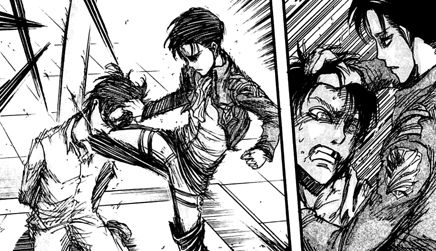
The issue is, it was an act. Eren forgives Levi almost immediately because he understood that Levi said those things to save Eren's life. It was an act to make his decision more appealing to military structure.
So the example that most people point to actually gives greater evidence that Levi has Ti as a role element. When he needs to adhere to structure to support his assessment of someone, he will rely exclusively on pre-established systems and hierarchies (such as the military). It explains why he never moves to "tweak" systems that are already there, and why he does not display any of the intellectual rigidity that Ti Base types typically exhibit in terms of worldviews and morality.
I found that instead, Levi relies far more on his character judgements of individuals, and his most important decisions in the series (deciding to spare Eren from execution, letting Erwin die) all stem from his examination of the intentions/motivations of others. He is very much a person tied to the "contracts" and obligations he forms with his close ones, and he determines what he ought to do next based on his readings of people. This is something that Levi does consistently.
Here are some examples throughout the series of Levi utilizing Fi > Ti.

Adolf Hitler was a SO2
"I cannot be mistaken. What I do and say is historical."
While Naranjo typed Hitler as an SX4, I believe this to be a mischaracterization of who Hitler truly was as a figure and a personality. Proponents of this view typically posit that Hitler was deeply resentful over the outcome of the First World War, his rough and unfair upbringing (as a result of his abusive father) and his failure in becoming an established artist. This self-loathing is then weaponized into hatred, with his theatrical nature being an excellent example of the SX4s "romanticization" of suffering, of which then he (and the German people) demand entitlement and retribution for.
However, what these readings have a tendency of forgetting is that Adolf Hitler had an almost overwhelming view of his own greatness. He believed that he alone was equipped to bring the German people to their position of greatness, and he positioned himself as the only means of doing so. This was not him exaggerating his sense of lack; it was elevating himself as an irreplacable figure to the movement, the solution to the problems that plauged his nation. He believed himself to be the primary authority on any intellectual matter, as he believed his own intuition granted him greater authority than experts.
"Since the events of last year, his faith in his own genius, in his instinct, or as one might say, his own star, is boundless. Those who surround him are the first to admit that he now thinks himself infallible and invincible. That explains why he can no longer bear criticism or contradiction. To contradict him is in his eyes a crime of the 'lese majeste; opposition to his plans, from whatever side it may come, is a definite sacrilege, to which the only reply is an immediate and striking display of his omnipotence."
- The French Yellow Book, pg. 945 (A Psychological Analysis of Adolf Hitler by CIA)
https://www.cia.gov/readingroom/docs/CIA-RDP78-02646R000600240001-5.pdf
To this end, Hitler is someone who believes he was guided by Providence, and this alone put him "on another level" compared to the ordinary man or leader. This fits in with the E2s fixation on "pride," or otherwise, endowing themselves with the position of being the one who can provide love and wisdom. Hitler possessed this defence mechanism since he was a child, with even his best friend August Kubizek stating that Hitler possessed a volatile temper, and would get furious whenever someone disagreed with him, even over the most minor of differences.
To Germany, he was the sole solution to all of their problems. He substituted genuine emotional connection for mass fame and adherence. Even as a struggling painter in Vienna, he would frequently retreat into the world of delusion, fantasizing about saving Germany in order to compensate for the lack of love and attention he received in childhood.
His fixation was not predicated on the "one-to-one" sphere but rather on the social instinct. A focus on belonging, social status, and contributing to a greater community. Merged with the passion and fixation of the E2, this creates the Social E2. Someone who believes they are the authority, that they are indispensable figures in the public space.
𝐅𝐋𝐕𝐄 - 𝐀𝐫𝐢𝐬𝐭𝐢𝐩𝐩𝐮𝐬:
𝐓𝐡𝐢𝐫𝐝 𝐕𝐨𝐥𝐢𝐭𝐢𝐨𝐧 > 𝐅𝐢𝐫𝐬𝐭 𝐕𝐨𝐥𝐢𝐭𝐢𝐨𝐧 (3𝐕 > 1𝐕)
Napoleon is one of those figures that is very much misunderstood because of the mythos surrounding him. But you'll find pretty quickly in historical evidence that Napeoleon was quite an insecure individual. This view is shared by many historians and experts.
Not about his height or anything like that (he was actually about average height for the time), but he famously held insecure views about his status and his class, and he acquired a pretty thin skin regarding criticisms in this area. He was born from a "low" background and lacked a connection to nobility, which fueled his desire to climb up the ranks. He held an obsession with class structure, legacy, and control over his public image.
This ranged from commissioning great works that compared him to figures such as Caesar to, during his coronation as Emperor, staging himself grabbing the crown from the king to demonstrate to no one that only Napoleon himself gave his own right to rule.
Simply, this is someone who is definitely not self-assured in his right to seize power. He needs to repeatedly prove it and to deny people the right to critique his standing.
Don't believe me? He even went as far as during the 1802 Treaty of Amiens to have the British agree to ban anyone who would mock him, seeking to persecute cartonnists who portrayed him negatively, such as James Gillray, to the point where Napoleon reportedly said that Gillray "did more than the armies of Europe in bringing him down."
Unsurpisingly (and hilariously), the British refused.
In PY, First Volition is someone who acts like a "king" without needing external validation. It is someone whose place and goals in the world are self-assured, and don't need any explanation.
Historical evidence suggests that Napoleon is... well, not that guy.
This is someone who fits in with 3V,
"Understanding the subtleties of social hierarchy is a constant pursuit for 3V. They strive to realize and raise their status in society, while evaluating other people from the point of view of their place on the social ladder."
"Third Volitions are inclined to defend their social status by any means – including lies and pretense. They use “pretense” to try to show themselves as better than they really are. Their slogan is “better to seem than to be” (unlike 1V, for example)."
Additionally, insecure 3L does not fit Napoleon at all, nor does it fit his readiness to study, read, and execute information nor collaborate with experts in discerning the best plan forward. His establishment of the Napoleonic Code, the Corps System, etc., all indicate a flexibility and willingness to collaborate in this aspect. He is not one to focus on circular logic or a need to justify his conclusions as a 3L typically would. There is no insecurity from Napoleon in this area.
For his first placement, I would suggest Physics (1F). Napoleon had an unshakeable confidence in his access to material and in his physical capabilities. This would lead to him being universally loved by his troops, as his brazen nature led him to the front lines alongside his men. As a consequence, he was known for developing a series of chronic issues because of his overconfidence in physicality, such as a chronic bladder condition, and severe fatigue from only sleeping 3-4 hours a night.
He even once boasted that winning at Waterloo would be as easy as "eating breakfast," despite suffering from severe hemorrhoids that left it far too painful to even sit on a horse.
This is also the source of a few strategic errors, as he fails to take into account the significance of the elements in logistical planning, such as the disastrous invasion of Russia, in which he repeatedly warned about the brutal climate and rough terrain. This failure to take heed of the physical limitations of his men led to the decimation of his forces not from battle, but from Russia's harsh climate.

𝐃𝐨𝐧𝐚𝐥𝐝 𝐓𝐫𝐮𝐦𝐩 𝐢𝐬 𝐚𝐧 𝐒𝐋𝐄 (𝐄𝐒𝐓𝐩)
"𝘋𝘰𝘯𝘢𝘭𝘥 𝘛𝘳𝘶𝘮𝘱, 𝘧𝘳𝘰𝘮 𝘢 𝘷𝘦𝘳𝘺 𝘦𝘢𝘳𝘭𝘺 𝘢𝘨𝘦, 𝘥𝘳𝘦𝘸 𝘴𝘵𝘳𝘦𝘯𝘨𝘵𝘩 𝘢𝘯𝘥 𝘴𝘵𝘢𝘵𝘶𝘳𝘦 𝘧𝘳𝘰𝘮 𝘥𝘦𝘯𝘪𝘨𝘳𝘢𝘵𝘪𝘯𝘨 𝘰𝘵𝘩𝘦𝘳𝘴, 𝘧𝘳𝘰𝘮 𝘪𝘯𝘴𝘶𝘭𝘵𝘪𝘯𝘨 𝘩𝘪𝘴 𝘱𝘦𝘦𝘳𝘴, 𝘧𝘳𝘰𝘮 𝘱𝘳𝘦𝘴𝘦𝘯𝘵𝘪𝘯𝘨 𝘩𝘪𝘮𝘴𝘦𝘭𝘧 𝘵𝘰 𝘵𝘩𝘦 𝘸𝘰𝘳𝘭𝘥 𝘢𝘴 𝘴𝘰𝘮𝘦𝘰𝘯𝘦 𝘸𝘩𝘰 𝘸𝘢𝘴 𝘯𝘰𝘵 𝘵𝘰 𝘣𝘦 𝘧𝘰𝘰𝘭𝘦𝘥 𝘸𝘪𝘵𝘩, 𝘯𝘰𝘵 𝘵𝘰 𝘣𝘦 𝘪𝘯𝘴𝘶𝘭𝘵𝘦𝘥 (...) 𝘛𝘩𝘪𝘴 𝘸𝘢𝘴 𝘩𝘰𝘸 𝘩𝘦 𝘮𝘢𝘯𝘢𝘨𝘦𝘥 𝘵𝘰 𝘱𝘶𝘵 𝘩𝘪𝘮𝘴𝘦𝘭𝘧 𝘢𝘵 𝘤𝘦𝘯𝘵𝘦𝘳 𝘴𝘵𝘢𝘨𝘦, 𝘣𝘦𝘤𝘢𝘶𝘴𝘦 𝘵𝘩𝘢𝘵’𝘴 𝘸𝘩𝘦𝘳𝘦 𝘩𝘦 𝘴𝘢𝘸 𝘴𝘶𝘤𝘤𝘦𝘴𝘴.
𝘈𝘯𝘥 𝘴𝘰 𝘪𝘯 𝘵𝘩𝘢𝘵 𝘸𝘢𝘺, 𝘣𝘺 𝘯𝘰𝘵 𝘭𝘰𝘴𝘪𝘯𝘨, 𝘣𝘺 𝘣𝘦𝘪𝘯𝘨 𝘵𝘩𝘦 𝘭𝘢𝘴𝘵 𝘮𝘢𝘯 𝘴𝘵𝘢𝘯𝘥𝘪𝘯𝘨, 𝘣𝘺 𝘣𝘦𝘪𝘯𝘨 𝘵𝘩𝘦 𝘰𝘯𝘦 𝘸𝘩𝘰 𝘸𝘢𝘴 𝘱𝘦𝘳𝘤𝘦𝘪𝘷𝘦𝘥 𝘢𝘴 𝘵𝘰𝘶𝘨𝘩𝘦𝘴𝘵, 𝘮𝘰𝘴𝘵 𝘴𝘵𝘶𝘣𝘣𝘰𝘳𝘯, 𝘵𝘩𝘢𝘵’𝘴 𝘩𝘰𝘸 𝘩𝘦 𝘱𝘶𝘵 𝘩𝘪𝘮𝘴𝘦𝘭𝘧 𝘢𝘵 𝘤𝘦𝘯𝘵𝘦𝘳 𝘴𝘵𝘢𝘨𝘦.𝘈𝘯𝘥 𝘤𝘦𝘯𝘵𝘦𝘳 𝘴𝘵𝘢𝘨𝘦 𝘧𝘰𝘳 𝘩𝘪𝘮 𝘸𝘢𝘴 𝘮𝘰𝘳𝘦 𝘪𝘮𝘱𝘰𝘳𝘵𝘢𝘯𝘵 𝘵𝘩𝘢𝘯 𝘵𝘩𝘦 𝘣𝘪𝘨 𝘢𝘤𝘩𝘪𝘦𝘷𝘦𝘮𝘦𝘯𝘵."
- Marc Fisher (co-author of Trump Revealed)
Throughout Trump's life, he had a fixation and skill of asserting his will onto the enviornment. To become successful, you need to dominate, and to dominate you need to do whatever is necessary to get ahead. Applying pressure, using the power at your disposal to get things moving, etc. I don't think it's uncommon to say that Trump is a clear Se Base, so I would rather dedicate time to focusing on his relationships with others.
Simply, Trump prioritizes consistent treatment of people which is predicated on whatever worldview/principle serves his need for power, attention, and influence. If you examine all of Trump's decisions, no matter how nonsensical they are, they are always predicated on "might makes right." He does not make deals on a case-by-case basis with people/nations by using simply what works in that context. Instead, when he decides to make a decision, he applies it unilaterally. Individual relations with people, nations, etc; these don't matter insofar as his appetite for power is satisfied. He does not respect weakness, and if he sees weakness (no matter the relationship), he will apply more pressure to get more out of it.
His entire foreign and economic policy is predicated on the belief that the United States holds the largest degree of power in the world, so therefore, it gets to solely negotiate the terms of the deal. It is why he can make a deal with a country, and within the span of a couple days, quickly violate that same deal. It's simply because he believes he can. His belief that strength triumphs over everything else gives him credence to demean and bully others into submission (Ti Creative).
Additionally, in the sphere of sentimentality, Trump has always had difficulty maintaining long-term relationships outside of their immediate transactional quality. His marriage to Ivana Trump was one originally predicated on a mutual need to bolster their image as a "power couple." But Trump grew quickly jealous of the attention she received (in short, she was intruding on his territory), and their marriage fell apart soon afterwards due to his outbursts and extramarital affairs. His marriage to Marla Maples ended up much the same way.
Even his working relationships also tend to suffer as a result and even bring along with them blowback at times. Many of his allies in the political sphere have now gone on to become his adversaries, high-profile figures such as John Kelly, Mike Pence, Bill Barr, James Mattis, Mark Esper, Nikki Haley, etc. There is a lack of attention in preserving individual loyalty, or deepening relations based on sentiment. To Trump, relations with people and business partners are purely transactional, and what a person can "do for him" in his conquest for power and fame. So when negative circumstances occur in the relationship, there is very little holding it together (Fi POLR).
Damon "Rust" Mercer is an SEE (ESFp)
So this is me testing how typing user profiles works on Albatross, and it's also a way of rectifying a few mistakes I've made on my typing journey. When I was relatively new to socionics, I made a few inaccurate typings of people (Rust included)...which will haunt me to my grave. But as I've gotten to know Rust better, alongside assessing his interactions with his community (and improving in my knowledge of socionics), I not only know, but firmly believe that SEE (ESFp) works very well for him.
(Se-Fi Ego) / Ti POLR
It's pretty easy to see that Rust is Se Base, as he is noticeably geared towards pursuing a sort of conflict. You can see this in almost everything he does, whether it is down to how he combats opposing typology systems, mobilizing his community to "go to war" against sources of misinformation, and even things as small as his choices in how he presents himself. There is a certain "presence," and he wishes to make an impact. There is a desire to use his volition and applying force to get things moving in order to accomplish what he seeks.
To do this, I found he is relatively skilled at creating, maintaining, and breaking social connections as they require. I remember you mentioning at one point that you have created many different communities in the past, and have "decapitated" them once they got too out of control for your tastes. It shows a willingness to engage with people, regardless of beliefs, and a strength in using those connections to achieve your goals. You are able to set the right amount of "closeness" with each person.
In contrast, SLEs (Rust's second most likely type) has a difficulty in maintaining interpersonal connections. It's not that they don't care, but they usually treat everyone the same in accordance with an underlying structural framework, principle, or ideology (Ti > Fi). However, I see that Rust tends to buck against systems/structures (even in typology) if they present themselves to be too firm and constricting. I have noticed a tendency (and it's not always a bad thing) to reject relying on one author too much, being too loyal to a system that it begins to ignore practicality, or throwing out systems that have too much a basis in theoretical application. It's not that you are unaware of this fact per se, but you reject systems and structures that are too unyielding and stifle individual expression and choice. This seems to fit more reliably into Ti POLR, which is a knowing suppression of a systematic, "one size fits all" approach to ethics/relationships, in favour of personal sentiments and individual character judgement.

𝐓𝐨𝐧𝐲 𝐒𝐨𝐩𝐫𝐚𝐧𝐨 𝐢𝐬 𝐚 𝐒𝐞𝐥𝐟-𝐏𝐫𝐞𝐬𝐞𝐫𝐯𝐚𝐭𝐢𝐨𝐧 𝐄8
"𝘞𝘦'𝘳𝘦 𝘴𝘰𝘭𝘥𝘪𝘦𝘳𝘴. 𝘚𝘰𝘭𝘥𝘪𝘦𝘳𝘴 𝘥𝘰𝘯'𝘵 𝘨𝘰 𝘵𝘰 𝘩𝘦𝘭𝘭. 𝘐𝘵'𝘴 𝘸𝘢𝘳. 𝘚𝘰𝘭𝘥𝘪𝘦𝘳𝘴 𝘬𝘪𝘭𝘭 𝘰𝘵𝘩𝘦𝘳 𝘴𝘰𝘭𝘥𝘪𝘦𝘳𝘴. 𝘞𝘦'𝘳𝘦 𝘪𝘯 𝘢 𝘴𝘪𝘵𝘶𝘢𝘵𝘪𝘰𝘯 𝘸𝘩𝘦𝘳𝘦 𝘦𝘷𝘦𝘳𝘺𝘰𝘯𝘦 𝘪𝘯𝘷𝘰𝘭𝘷𝘦𝘥 𝘬𝘯𝘰𝘸𝘴 𝘵𝘩𝘦 𝘴𝘵𝘢𝘬𝘦𝘴, 𝘢𝘯𝘥 𝘪𝘧 𝘺𝘰𝘶 𝘢𝘳𝘦 𝘨𝘰𝘪𝘯𝘨 𝘵𝘰 𝘢𝘤𝘤𝘦𝘱𝘵 𝘵𝘩𝘰𝘴𝘦 𝘴𝘵𝘢𝘬𝘦𝘴, 𝘺𝘰𝘶'𝘷𝘦 𝘨𝘰𝘵 𝘵𝘰 𝘥𝘰 𝘤𝘦𝘳𝘵𝘢𝘪𝘯 𝘵𝘩𝘪𝘯𝘨𝘴. 𝘐𝘵'𝘴 𝘣𝘶𝘴𝘪𝘯𝘦𝘴𝘴."
- Tony Soprano and the E8 Defence Mechanism of Counter-Introjection
The biggest character flaw I found in Tony Soprano is his need to rationalize his behaviour. This flaw permeates everything he does; his constant need for control, for domination of the surroundings around him; It is all about the individual's satisfaction of their needs, and a willingness to be a "bandit" in order to acquire his resources. It also directly gets in the way of his growth, despite Tony being offered several chances at redemption.
Additionally, Tony *knows* he does bad things but then seemingly tries to justify his actions by stating he was raised in a "harsh world" (a very hypocritical stance in which many people have tough upbringings but don't abuse the people around them). In his meetings with Melphi, he will blame almost everything but himself (truthful or not). He will blame his mother's raising of him,
Tony does many things to rationalize his obviously poor behaviour and often rationalizes himself as a "soldier," insofar as everyone involved knows the stakes and that he "won't go to hell" because he is simply playing the game. Of course, this conveniently leaves out all of the people that the mob regularly tortures, manipulates, and intimidates into submission—people who never agreed to play the game in the first place. What about all the innocent lives that fall victim to Tony and his New Jersey empire? Do they get a say? Simply put, Tony knows all this, and how many people suffer for his personal "needs" to be met (financial stability, status, etc). But he often justifies this poor treatment of others with the conclusion that the world is fundamentally flawed, or a game in which people dominate or are dominated. If the rules of the game are such, is Tony truly a bad person for playing a role?
The E8 + the Self-Preservation Instinct takes the defence mechanism of counter-introjection (blaming the world/society around you for poor behaviour), and directs it towards gaining material needs. This is why Naranjo uses the "used car salesman" as an image of an SP8, because these types will do or say anything to obtain an advantageous position, and will rationalize anyone falling victim or getting swindled as "not being skilled enough at the game." The world operates as a system, and those who can't play the system to win are dropped.
Of course, this is all a psychological shield to protect Tony from feelings of guilt. Counter-introjection is present with Tony throughout the series, and there is a very large argument to be made (one that Dr. Melphi has) that Tony uses his therapy sessions in order to further justify his poor decisions and choices, instead of taking the steps to truly change. If one examines Tony's development throughout the several seasons of the Sopranos, Tony remains exceptionally consistent throughout (minus small pangs of guilt that he immediately sweeps under the rug).
This inability to truly acknowledge his vulnerability and humanity (and ability to truly feel remorse for his victims), and instead trying to blame everything else for his behaviour, is the biggest reason why Tony Soprano never changes, and ultimately winds up shot in the finale, despite being offered every possible chance of redemption.
𝐓𝐨𝐧𝐲 𝐒𝐨𝐩𝐫𝐚𝐧𝐨 𝐢𝐬 𝐚𝐧 𝐒𝐋𝐄 (𝐄𝐒𝐓𝐩)
"𝘠𝘰𝘶 𝘥𝘰𝘯'𝘵 𝘩𝘢𝘷𝘦 𝘵𝘰 𝘭𝘰𝘷𝘦 𝘮𝘦, 𝘣𝘶𝘵 𝘺𝘰𝘶 𝘸𝘪𝘭𝘭 𝘳𝘦𝘴𝘱𝘦𝘤𝘵 𝘮𝘦."
(Se-Ti Ego / Fi POLR)
Tony Soprano is an individual that focuses on material acquisition, control, and using force/intimidation to achieve his own ends. This is his go-to approach, even in unknown/unique situations. Sudden rage, threats, and violence are all tactics used to re-establish control. He does this with his subordinates, but also his close family members and friends who are not even involved in the mobster lifestyle. This element with Tony is bold, assertive, and loud (everyone around him, and audiences notice it). Se Base obviously fits best here.
Secondly, I would argue Ti Creative is the second half of his ego-block. I mentioned this in the E8 Assessment, but Tony has a tendency for crafting self-serving ideologies and frameworks to justify his poor behaviour and prioritizes this tendency over creating flexible relationships with specific people. He then treats everyone consistently in accordance with the framework he adopts in that moment. If you examine Tony's behaviour with people throughout the series, his behaviour does not shift often depending on the people he speaks to. In short, he not only does not "rely" on the obligations he sets in his relationships, he uses these "relational contracts" as simply an excuse to engage in poor behaviour. There is a reason why The Sopranos examines concepts such as what it means to be "a family man," an Italian," "a member of the mob," etc. It examines roles in systems and structures, and these are the topics Tony frequently uses to assist whatever goals he has.
Control is something based on dominance, and respect is imposed through dominance. Positing himself as a "simple soldier" in the mob war relinquishes himself of all the guilt/remorse, and enables him to act without hindrance. All these factors indicate that Tony uses self-serving frameworks to facilitate his need for control and dominance, and therefore, throwing away your framework that asserts that "might makes right" for specific individuals relinquishes your power (via an ideology that permits free movement).

𝐏𝐨𝐰𝐝𝐞𝐫 "𝐉𝐢𝐧𝐱" 𝐢𝐬 𝐚𝐧 𝐄𝐒𝐈 (𝐈𝐒𝐅𝐣/𝐈𝐒𝐅𝐏)
—————————————————————
"𝘠𝘰𝘶 𝘯𝘦𝘷𝘦𝘳 𝘭𝘦𝘧𝘵. 𝘐 𝘢𝘭𝘸𝘢𝘺𝘴 𝘩𝘦𝘢𝘳𝘥 𝘺𝘰𝘶. 𝘚𝘩𝘢𝘥𝘰𝘸𝘴 𝘪𝘯 𝘵𝘩𝘦 𝘴𝘵𝘳𝘦𝘦𝘵𝘴, 𝘱𝘳𝘪𝘤𝘬𝘭𝘦𝘴 𝘰𝘯 𝘵𝘩𝘦 𝘣𝘢𝘤𝘬 𝘰𝘧 𝘮𝘺 𝘯𝘦𝘤𝘬. 𝘠𝘰𝘶𝘳 𝘷𝘰𝘪𝘤𝘦. 𝘗𝘶𝘴𝘩𝘪𝘯𝘨 𝘮𝘦. 𝘗𝘪𝘤𝘬𝘪𝘯𝘨 𝘮𝘦 𝘶𝘱 𝘸𝘩𝘦𝘯 𝘢𝘭𝘭 𝘵𝘩𝘦 𝘤𝘰𝘭𝘰𝘶𝘳𝘴 𝘸𝘦𝘳𝘦 𝘣𝘭𝘢𝘤𝘬."
Fi Base - Se Creative / Ne POLR
Contrary to popular belief, Jinx is not a strong intuitive type. She is impulsive, does not think things through effectively, and requires concrete examples of loyalty to gain her trust. Jinx does not operate based on possibilities and unknowns; in fact, I would say outright that she outright dislikes any sort of uncertainty in her relationships. She wants love and loyalty in clear, absolute terms: not just spoken words of affirmation, but grounded evidence. I don't understand where PDB voters get Ne Base, or the sometimes loud, but almost always controlled facade of the EIE (outward emoting in support of positive long-term outcomes).
The sphere of relations formulates her motivations; it drives her actions, and it fuels her neurosis as the story progresses. Once she gets a sense of the relationship she wishes to pursue, she does not stop nor change her mind easily. This explains her complex loyalty to Vi (despite, from her perspective, Vi betraying her), her standing by Silco despite knowing he lied to her on numerous occasions, and her deep bond with Isha (despite only knowing her for a few months), and her deep hatred of Caitlyn (that stems from her feeling as if Vi replaced Jinx with her) that forms within mere moments of meeting her. If she does change her mind on someone, it is after circumstances and repeated exposure force her to find common ground with them (such as Silco's former bodyguard, Sevika).
All of Jinx's motivations stem from her relationships with others. Once she gets a grasp of the sort of relationships she wants, she acts quickly to pursue/enforce it (whether that is chasing after love or bringing about retribution). Fi Base makes the most sense here, as Fi is all about relations, and character assessment. Second, Jinx does not spend time pondering the state of a person's character before making a judgment. She moves and executes quickly, not interested in exploring every facet of a person before moving. Fi-Se, and then eliminating nuance and possibilities via Ne POLR fits Jinx far more. In healthy individuals, it makes these types very loyal, and wanting to demonstrate their loyalty quickly and in grounded terms. In Jinx, it increases her unpredictability as her neurosis grows.